
Electric Car Converts are proud to have been entrusted with the electric conversion of ‘Evie’, a 1955 Series I Land Rover, preparing it to embark on an exciting expedition.
Owner Ed Barsley plans to drive Evie around the world, covering a total of 18,000 miles across 20 countries and six continents, in memory of his late father John.
If successful, this vehicle will become the first electric classic car to circumnavigate the globe.
Before setting off in March 2027, Evie is making her first public appearances at the Everything Electric show (11–12 September), and at Goodwood Revival (18–20 September).
The journey aims to show that a vehicle of this age can be adapted for a lower-carbon future without sacrificing the history, character or capabilities worth preserving.
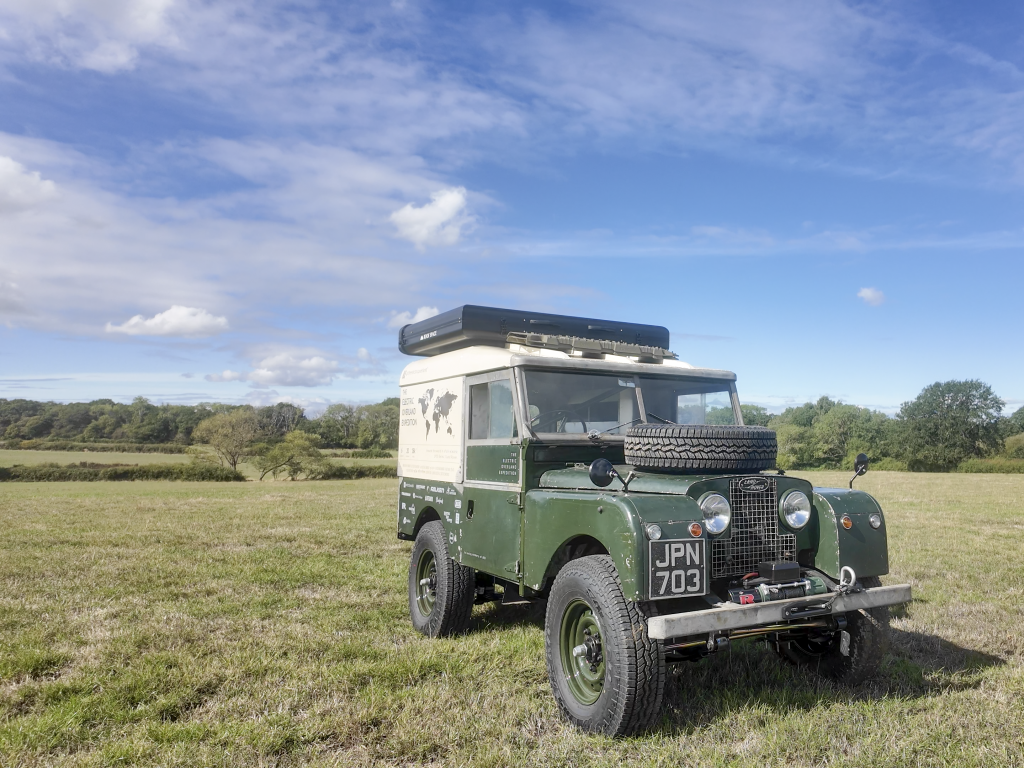
Building the Electric Overlander
ECC’s conversion of Evie uses two Fellten 55kWh UBP-55E battery packs and a Tesla Model 3 motor. The motor is set up to tackle the terrain with ease, with 194 Kw of power and 340 Nm of torque.
The new electric powertrain allows 7kW AC charging and up to 70kW DC fast-charging, vehicle-to-load capability and a range of up to 375 miles.
The Land Rover’s 4-wheel drive capability has been retained, along with as much of the original bodywork as possible. The Tesla model 3 motor has been upgraded with a Quaife limited slip differential along with all new gearing ratios and internals.
Additional bespoke features to set the vehicle up for it’s around-the-world adventure include:
- Customisable power and regenerative braking
- Upgraded disc brakes
- Heavy-duty Defender axles and uprated drivetrain
- 7kW water heater
- Willwood EPB
- Britpart Wolf wheels and FALKEN tyres
A Global Expedition – Risks and Route
The conversion changes how Evie is powered but does not diminish the risks of a global expedition. A vehicle of this age must withstand sustained long-distance driving, remote roads, extremes of heat and cold, dust and mountainous terrain. The team must also negotiate differing EV charging standards, variable electricity supplies (often in remote places), ports, customs, visas, border crossings and shipping schedules. A serious mechanical or electrical failure, a closed border or a missed sailing could compromise the route, or bring the attempt to an end.
The planned route runs from England through France and Spain to Morocco; on to Brazil, Argentina and Chile; across the United States; through New Zealand and Australia; then Singapore, Malaysia, Thailand and India; and home through Turkey, Serbia, Bulgaria, Croatia, Slovenia and Italy. Sea freight will connect the sections of the route that cannot be driven: Morocco to Brazil, Chile to the United States, the United States to New Zealand, New Zealand to Australia, Australia to Singapore, Thailand to India, and India to Turkey.
Dr Ed Barsley, expedition lead, comments:
“This expedition is personal, pertinent and I believe possible. Along the way, Evie and I will travel through landscapes already being shaped by climate risk and rapid change. I want to tell a wider story about resilience, not by discarding the past, but embracing how we can adapt it for the future.”
Toby Wilson, Director and Chief Technical Officer at Electric Car Converts says:
“It has been a great engineering challenge to build a bespoke, robust system for Ed’s round the world trip. We’ve taken our tried and tested Series bolt-in kit but made it more rugged and ready, and put extra redundancies in place for those times where Ed needs ultimate strength reliability in the middle of nowhere.
Ed’s passion for the project is so clear and the whole story behind the expedition is a wonderful motivator to create something resilient and enduring. We’re thrilled to have been part of it.”
Follow the expedition at: www.theelectricoverland.com and on Instagram: @theelectricoverland.