
The Land Rover is more than just a vehicle on a farm, it’s a workhorse, a companion, and in many cases, a piece of family history.
Whether it’s a Series III that’s been on the farm for decades or a Defender that tackles the fields every day, these vehicles are built into the fabric of British agriculture. But as farming evolves and sustainability becomes more important, many farmers are asking the same question: What if I could keep my Land Rover and make it electric?
At Electric Car Converts, we specialise in exactly that. This guide explores how an electric conversion can work for you, our fellow UK farmers, from everyday field use, to livestock management to shooting and hunting estates.
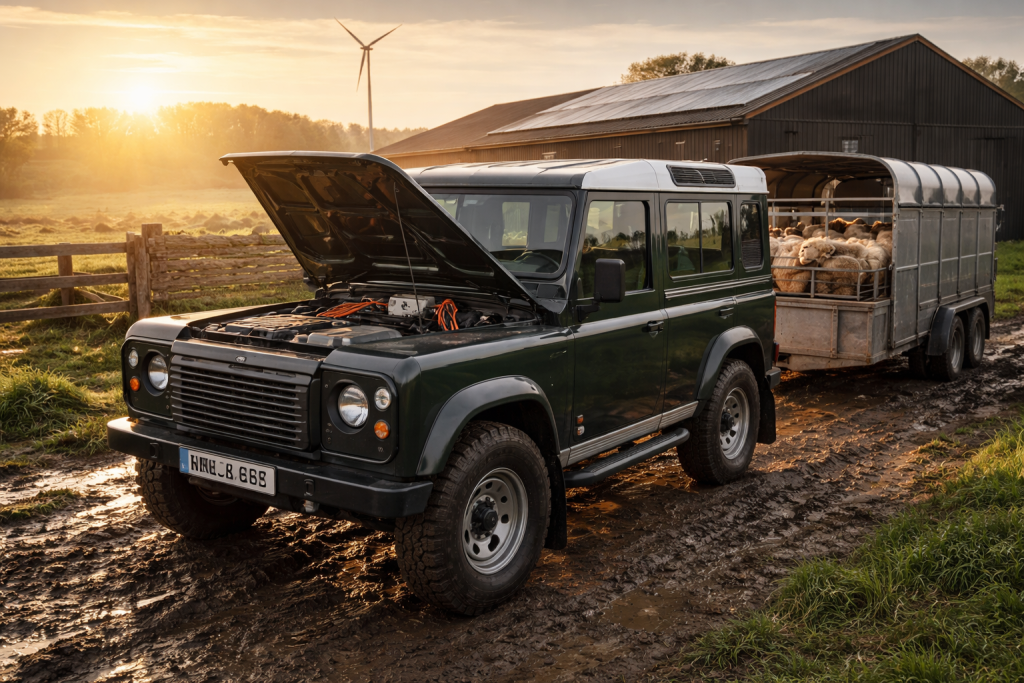
Why Convert Instead of Replace?
For many farmers, the idea of replacing a trusted Land Rover with a brand-new vehicle, electric or otherwise, simply doesn’t make sense. Your vehicle knows the land. You know your vehicle. The bodywork, the modifications, the tow points, everything is already set up for your specific needs.
An electric conversion lets you retain all of that while upgrading to a cleaner, quieter, and cheaper-to-run powertrain. You’re not starting from scratch rather improving what already works.
Agricultural Uses Across the UK
General Farming and Field Work
Day-to-day farm operations are where an electric Land Rover truly shines. Electric motors deliver instant torque, which is ideal for slow, controlled towing and pulling – something diesel engines have always been appreciated for, but electric powertrains do just as well, if not better.
Livestock Farming
Electric vehicles are particularly well-suited to livestock farming. Cattle, sheep, and other animals are sensitive to noise – a quiet electric motor causes far less disturbance than a rattling diesel engine. The Farmers who have already converted their Land Rovers with Electric Car Converts report that a quieter vehicle means calmer animals during feeding, herding, and vet checks. For lambing season, calving, or working closely with horses, this can make a meaningful difference to both the animals and the farmer.
Shooting and Hunting Estates
Our trusty Land Rovers are the vehicle of choice for game shoots and deer stalking. Noise is the enemy on a driven shoot or during a stalk – and an electric conversion addresses this directly. A near-silent vehicle allows estate managers and keepers to move around the land without disturbing birds or deer, making the electric Land Rover a genuinely practical upgrade for this type of work.
Arable and Mixed Farming
On arable farms, the Land Rover is used across the entire growing season – from soil preparation checks in early spring to harvest supervision in late summer. Electric conversions work well in these environments because routes tend to be relatively predictable and the vehicle returns to a central yard each night, where it can recharge overnight. This pattern suits electric vehicles perfectly.
Smallholdings and Market Gardens
Smaller agricultural operations – smallholdings, horticultural enterprises, and market gardens- often operate on tighter margins. For these, the lower running costs of an electric vehicle can be more meaningful. Less spent on fuel and less frequent maintenance means more money stays in the business. The Land Rover’s versatility on a smallholding -carrying produce, towing a small trailer, getting into muddy corners – is preserved entirely after conversion.
Forestry and Woodland Management
Woodland owners and forestry workers in the UK rely on 4×4 vehicles to access difficult terrain year-round. Whether managing a commercial timber operation or a conservation woodland, an electric Land Rover handles the demands of off-road woodland tracks while producing zero emissions on site — important for those working under environmental stewardship schemes or on nature reserve land.
Equestrian and Horse Farming
Horse owners and equestrian businesses depend on a capable tow vehicle for transporting horses in trailers and lorries. Electric Land Rovers maintain the towing capability required, while the reduced noise and vibration make them significantly less stressful for horses — both when loading and during paddock work.
Practical Considerations for Farmers
A few things worth thinking about before going ahead with a conversion:
- Range: Most farms operate within a predictable daily range. Modern electric conversions offer sufficient range for a full day’s work on most UK farms, and overnight charging at the yard is simple to set up.
- Charging: A standard three-phase supply – common on UK farms – makes charging straightforward. Most farmers find that overnight charging meets all their daytime needs.
- Off-road capability: The electric motor
retains orimproves the low-speed torque essential for off-road work. Ground clearance and 4WD systems remain intact. - Cold weather: UK winters can be harsh. Battery performance in cold conditions is something to discuss with our team — insulation and battery management systems are well-developed and proven in agricultural environments.
The Conversion Process
At Electric Car Converts, we take your existing Land Rover and replace the internal combustion engine with a purpose-built electric drivetrain. The body, chassis, and all your existing modifications remain. The process typically takes several weeks and results in a vehicle that looks exactly as it did before – just with a fundamentally better powertrain underneath.
From a British-owned company, a British team of engineers, British equipment, serving you, our British farmers. We work with farmers across the UK and understand the specific demands placed on agricultural vehicles. Every conversion is tailored to the way you use your Land Rover, ensuring the result works for your farm – not just on a test track.
Get in Touch
If you’re a farmer, estate manager, or land owner considering an electric conversion for your Land Rover, we’d love to hear from you. Get in touch with the Electric Car Converts team to discuss your vehicle, your land, and what an electric conversion could mean for you.