
Hi everybody, this is Barnaby from Electric Car Converts.
Right, this one’s a bit special. We’ve just finished something I’m fairly certain no one else has even attempted: a 110 kWh electric system in a Defender 90. Usually, that big pack goes in the long-wheelbase 110s. This time we thought, “Let’s stick it in a short wheelbase and see what happens.” Turns out you get the longest-range EV Defender 90 on the planet.
For context, the only car on UK roads with a bigger battery is the new EV Merc G-Wagon! Which is… not bad company to keep.
A Wind Turbine Could Charge It in 55 Spins
Here’s a stat I love at the moment: one rotation of a wind turbine makes somewhere between 1 and 4 kWh. Let’s call it 2 to be sensible. That means 55 spins, and this thing’s full, about 280 miles of range.
Compare that to filling it up with diesel, the noise, the smell, and you start to see why I’m a bit giddy about this build.
Weight Worries? Forget It
People always ask, “Yeah, but isn’t it heavy?” So, we took it down to the weighbridge. 2,100kg. Diesel 90? 1,950kg. So, 150kg more. That’s about the same as two of your mates after a big lunch. And remember, engines, gearboxes, and radiators, a full tank – not exactly lightweight to begin with.
Driving the Electric Defender 90
We’ll start the way I always do: the original key goes in, twist it, and you hear the relays click; the dash then wakes up. Select drive, handbrake off, and off we go.
It’s still a Land Rover, still bumpy, still got the charm, but quieter. Good door seals, proper sound deadening, and no diesel clatter. At 30mph, I can talk like this without raising my voice. In the old 300TDI, I’d have changed gear four times by now.
0–60? Around 5–6 seconds, depending on weight and charge. Quick enough that it’ll surprise a Porsche if you feel like being childish, but that’s not what this is about.
Pop the Bonnet
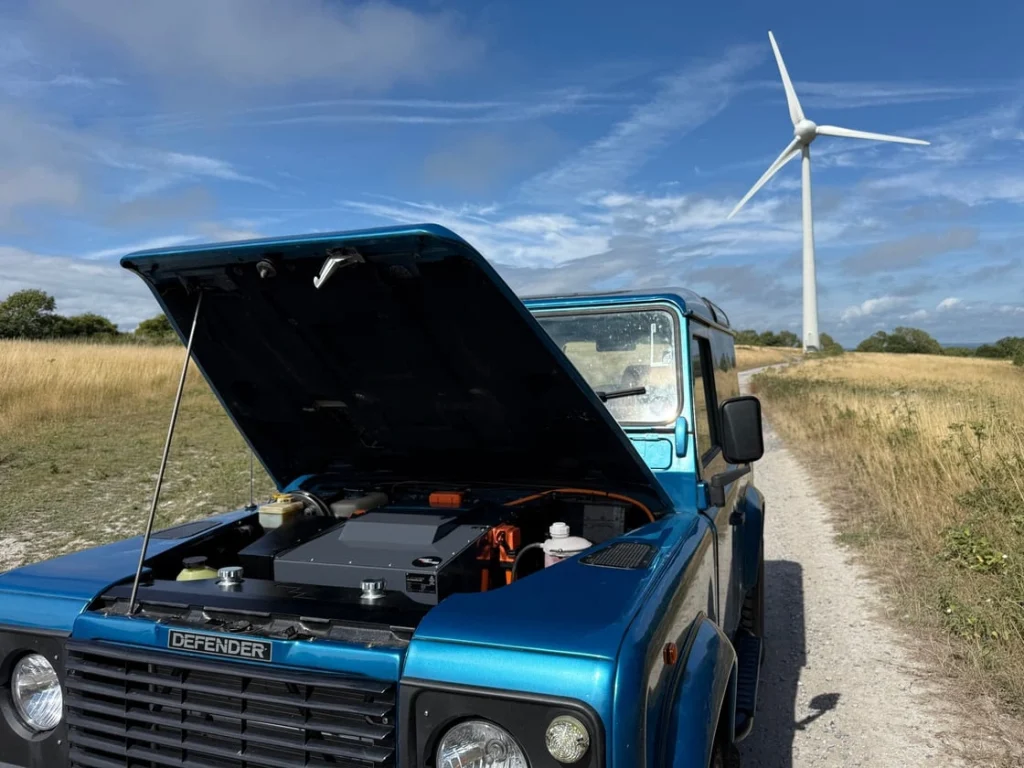
Originally, this had a 300TDI diesel. Now, there’s a 55 kWh Fellten battery pack up front, VW ID series modules, built in Bristol. Inside you’ve got:
- BMS keeping tabs on temps and current flow
- Contactors, basically the ignition for the high-voltage stuff
- CCS controller for rapid charging
- Big high-voltage disconnect and fuse, so no one gets fried
That front pack also features high-voltage heating, a DC-DC converter (which is our alternator replacement), and leaves the original 12V system intact for lights, wipers, and all the usual accessories.
We’ve retained the original brakes (powered by an electric vacuum pump), the original steering box (now equipped with a 12V pump), and the original radiator pack, which now cools a motor and batteries instead of an engine.
Doubling the Range
Most customers stick with just the front pack. However, in a Defender, we can fit another 55 kWh under the seat box. This one’s got it, so instead of about 150 miles, you’re now at around 300. And you don’t lose an inch of load space.
Weight’s balanced nicely too, with 300kg up front and 300kg in the middle.
Charging Anywhere
Where the fuel filler used to be, there’s now a CCS port.
- Rapid charge: 45–50 mins to 80% (25 for the single-pack version)
- Type 2: home, lamp-post, wall box, anything a normal EV can use
If it charges a Nissan Leaf, it charges this.
Inside the Cabin
Still very much a Defender inside. You’ve got:
- Original binnacle, just with gauges for battery temp, SOC, and current
- Electric handbrake
- Drive selector in the middle
- Eco mode for sensible days, full power for fun days
Still rattles, still basic, because that’s the whole point.
Letting Off the Pedal
Lift your foot, and it slows you down; proper one-pedal driving most of the time. Saves brake pads and puts energy back into the battery.
We’ve set regeneration in the middle here, but with the app, you can adjust it. Same with power, turn it up if you’re feeling spicy, or right down if you’re letting your kid have a go.
Underneath: Where the Big Change Happens
Engine, gearbox, transfer box, all gone. In its place, a Tesla Model 3 Performance rear motor drives both axles through the propshafts.
Heavy-duty mounts go into the original chassis points. The second battery box is flush with the rails so it’s well protected.
We used to keep the old gearbox in our conversions. We don’t anymore, Tesla Motors’ smoother, quieter, and nicer thing to drive.
The Workshop and Kits
All done in-house: fabrication, wiring, and motor refurbishment. We also ship EV kits worldwide, including battery, motor, and mounts, ready to bolt in.
Pricing
Pricing is as follows:
- 55 kWh: £60,000 + VAT
- 110 kWh: £85,000 + VAT
Fitting is included in the UK.
If you want the Defender, not the wind turbine, you know where to find me.
See you at the next one.